

Tibetan singing bowls, also called Himalayan bowls and sound bowls, have been used for centuries for meditation, healing, and relaxation. Striking or rubbing a bowl with a mallet creates vibrations and mesmerizing harmonics that calm the body and still the mind, making them popular in various wellness practices today. In this guide, we’ll explore the history, benefits, and practical steps to use a Tibetan singing bowl and start a sound meditation practice.
What is a Tibetan Singing Bowl?
Tibetan singing bowls are made from a mix of bell-metal bronze. Although metallurgical analyses vary, they are predominantly an alloy of copper and tin. They are considered a standing bell, essentially like a Western bell turned upside down, and instead of being played with a clapper, it is struck or rubbed with a mallet. Most produce a flatted fifth chord, regardless of the pitch of the bowl’s dominant tone. Their soothing effects can benefit anyone seeking stress reduction and mindfulness.
Historical Background
There’s evidence of singing bowls being used for rituals and meditation tools in the cultures of India, the ancient Kingdom of Gandhara (present-day Pakistan and Northeast Afghanistan), Southeast Asia, China, Korea and Japan. Depending on the research, the use of singing bowls may date back some 4,000 years. Frank Perry’s compendium Himalayan Sounds Revelations – The Complete Singing Bowl Book provides evidence that the ancient Chinese were making bronze bells as early as 2000 BCE. In India, the bowls’ history can also be traced 2000 years back to ancient Vedic scriptures during the Ayurvedic age when the sage Charuk wrote that vibration and massage could be combined together to treat many illnesses.1

Tibetan oral tradition traces the migration of the bowls from India to Tibet along with the spread of Buddhism by the great Tantric master Padmasambhava in the 8th century A.D. When the Chinese People’s Liberation Army invaded Tibet in 1950, Tibetans began immigrating to Kathmandu, Nepal, and Northern India, bringing their culture and the bowls with them. When these areas became popular travel destinations for Westerners in the 60s and 70s, the term “Tibetan Singing bowl” was coined. Previously unknown in North American culture, the spread of Tibetan bowls gained prominence as healing tools in the 90’s. Over time, the bowls’ applications have expanded worldwide to multiple healing modalities such as sound healing, massage, Reiki, Acupuncture, Yoga, psychotherapy, psychiatry, and oncology adjunct treatments. In a relatively short amount of time, they have become mainstream stress reduction tools.
Benefits of Using a Tibetan Singing Bowl
There are multiple healing effects of singing bowls. Although the science behind the effects of singing bowls is in its infancy, there’s already a lot of scientific research demonstrating their physiological and psychological healing properties. Some of them include:

- Enhanced Meditation: Tibetan singing bowls produce binaural beats, which entrain our brainwaves from the busy Beta brainwave pattern of everyday life to the Alpha, and Theta states, slowing our brainwaves and naturally assisting us into meditation.
- Relaxation Response: Brainwave entrainment to the Alpha and Theta states produces a “relaxation response” in the body – the opposite of the “fight or flight” response. The relaxation response slows the breath, lowers the heart rate and blood pressure, easing tension, anxiety, and fatigue.2 This response triggers a positive feedback loop in the body, reducing cortisol levels in the blood and allowing the levels of “feel good” hormones to build up, thus creating a sense of well-being.
- Anti-Aging: Telomeres are little caps on each strand of our DNA that protect our cells from damage, the way those little plastic caps on shoelaces keep them from unraveling. Stress and anxiety degrade our Telomeres, exposing our cells to wear and tear as we age. Singing bowls massage us at a cellular level, and meditation has been shown to positively affect our Telomeres, slowing down the aging process of our cells.3
- Concentration: A core function of Tibetan bowls is to improve concentration. Through their binaural beat effect, singing bowls create a “frequency following response” that creates new neural pathways in the brain. Brain function has been shown to be enhanced through the increase of cross-collosal communication between the left and right hemispheres of the brain.4
- Mood: Depression has been linked to a hyperactive right brain (RH), the hemisphere that is involved in processing negative emotions and pessimistic thoughts, all of which contribute to depression and its resulting anxiety, stress, and emotional pain.5 So, the hemisphere-balancing effect of singing bowls may also contribute to the widely reported feeling of well-being after a sound treatment, which some report can last for days after.
- Sleep: Additionally, the RH controls our impulses for vigilance and arousal, which may explain why depression is often accompanied by sleep disturbances.5 Tibetan bowls have widely been shown to aid sleep by calming the nervous system, creating a positive feedback loop of benefits from getting enough sleep that enhances our health and quality of life.
- Mindfulness Practice: Sound is one of the principle anchors of mindfulness practice. Simply playing your bowl is a meditation.
Choosing the Right Bowl
When selecting a singing bowl, consider the following:

- Size: Both the size of the bowl and its thickness influence its frequencies. Larger bowls tend to produce lower tones, while smaller bowls produce higher pitches. But the thickness of the bowl’s wall increases the internal tension in the metal, resulting in a higher pitch. A triangulated lip on a bowl can raise its tones as well.
- Material: Traditional bowls are made from a bell metal alloy consisting primarily of roughly 80% copper and 20% tin – but there are traces of other metals, depending on the analysis. Despite the popular marketing, manufacturers who make true 7-metal alloy singing bowls are rare.
- Price: Larger bowls tend to be pricier, and smaller ones are more affordable for those just getting started. But when it comes to antiques, you will pay more for their age and rarity. Make sure you purchase from a reputable antique bowl dealer.

- Aesthetics: There are many varieties of finishes on contemporary singing bowls made today. Many will have acid-etched patterns, mantras, and sacred symbols; some will be highly machine-polished, golden with a mirror-like finish, while others will have a matte finish or a chocolate brown, chemically processed dark patina. Some antiques will be bronzy-golden, while others will be darker with green and black oxidation. The bowl’s appearance matters less than how easily it plays and, most importantly, its quality of sound.
- Sound: It’s all about the sound! Each of us is a unique, resonating entity. Despite the popular emphasis in North American and European sound healing circles on the diatonic scale or a specific tuning such as 432 Hz. There are many sound healing systems, each with a unique approach. The important thing is to go with what resonates with you! More often than not, a person who listens to 20 bowls ends up selecting the first one they heard! There’s something to the adage: you don’t so much choose the bowl – it chooses you.
Preparing Your Space
- Quiet Environment: A quiet, peaceful space is nice if you have one, but what’s really necessary is that the ambient room noise needs to be lower than the bowl’s sound so you can hear it. If you hear other sounds, practice concentrating on only the tone of the bowl, while allowing the extraneous sounds of your environment to be what they are.
Holding the Bowl

- Placement: Place the bowl on the palm of your non-dominant hand, with your hand energized and your fingers straight but not taut or strained. Make sure you maintain this position of your holding hand while you’re playing the bowl so the fingers of your holding hand don’t inadvertently curl up to hold your bowl, thus dampening the sound. Placing the bowl on the outer edge of the fingertips of the outstretched hand also helps avoid the hand’s natural tendency to grip the bowl while playing. If you’re just striking your bowl, it’s also fine to place it on a cushion, O ring or gripper mat. If it’s a larger, heavier bowl and you’re seated, you can rest your holding arm on your lap.
Striking the Bowl
- Using a Mallet: Make sure you use the covered end of a mallet for the strike, with wool or leather covering. Hold the mallet in your dominant hand, with a light grip of the mallet roughly in its center of gravity.
- Angle: Strike the bowl gently with the mallet at an angle on the exterior or interior wall, not directly on the rim. Experiment with different points around the wall to discover various sounds.
Rimming the Bowl
- Circular Motion: Hold the mallet in your dominant hand in its center of gravity, as if you were holding a large pen. Your fingers should be very close to the rim of the bowl – no more than an inch or even less. Place the mallet on the outside lip of the bowl, angling it slightly into the bowl’s interior, then rub the mallet around the rim’s circumference in a smooth, circular motion. Apply consistent pressure; this will create a continuous sound. Traditional Tibetan practice circles the bowl clockwise, but this is up to the practitioner. Once you have the circular motion down, you can also experiment with a back-and-forth motion.
- Listen: Pay attention to the vibrations and sounds. When the sound is as loud as it can go without overloading, slow your speed and increase your pressure just a little bit until the bowl’s tone evens out. Adjust your speed and pressure until the tone is consistent and sweet.
Incorporating Breath and Intention
- Mindful Breathing: As you play, be conscious to continue breathing naturally. It’s common for people to hold their breath when concentrating.
- Set an Intention: Before starting, set a clear intention for your practice, whether it’s relaxation, healing, or mindfulness.
Ending Your Practice
- Winding It Down: Slowly reduce the speed of the mallet around the rim until the sound fades and then gently lift the mallet off the rim. Allow the bowl to sustain until silent. If you hear a loud “zinging” sound when you lift your mallet, try lifting it off more vertically, like a helicopter taking off rather than an airplane.
- Reflection: Take a moment to tune into your body. Notice any difference between how you feel from when you started your practice.
Tips for Maximizing Your Experience
- Experiment: Try different mallets and techniques to discover the sounds you prefer. Isolating the fundamental will isolate the bowl’s lowest voice – rimming will isolate the bowl’s highest voice. Most larger and mid-size bowls also have a mid-tone (also called first interval) that you can isolate.
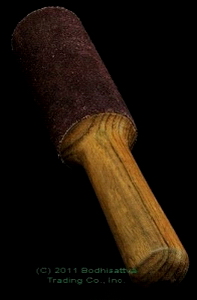
- Get to Know your Bowl: When striking, notice where the bowl’s sweet spot is: where its harmonics are harmonious, or more dissonant. Notice how the force of your hit changes the volume and harmonic balance. Most bowls come with dual padded mallets or gong mallets, and each end does something different. When striking, always use the wool or suede-padded end of the mallet for a better balance of the bowl’s lower harmonics. For larger bowls 10″ and up, usually gong mallets are provided. When rimming, use the wood side of the mallet. Notice the timbre of the bowl’s voice when it’s as loud as it can go. When you hear that tone, you know you’ve reached a comfortable threshold for the bowl, and you can reduce your acceleration while keeping your mallet pressure firm. The louder and clearer the bowl’s tone, the less speed you need to rim it.
- Regular Practice: Incorporate the bowl into your daily routine. If you already have a meditation practice, playing your bowl before sitting helps to quiet the mind. If not, start out by allocating five or 10 minutes at a convenient time every day to focus on your bowl practice. Some like to practice when they first get up to set the tone for the day; some before bedtime to calm the nervous system and prepare for sleep. You might try different times throughout the day to see which feels right for you. Some find it supportive to practice at the same time every day, while others are successful at improvising around a shifting schedule.
- Keep It Up: Unfortunately, the bowls can’t help unless they’re used. Some effort is required to start and maintain a practice, but the rewards are immediate and ongoing.
Conclusion
Using a Tibetan singing bowl can be a transformative experience, bringing peace, relaxation, and mindfulness into your life. Whether you’re a beginner or an experienced practitioner, embracing this ancient tool can enhance your well-being. So take the time you need to find your bowl, and let its soothing sounds guide you on a journey of self-discovery and tranquility.

1Samvahan Vibrational Healing from India, Kamala Thiagarajan, Massage Issue 117 Nov/Dec 2005
2 Effects of Singing Bowl Sound Meditation on Mood, Tension, and Well-Being: An Observational Study Journal of Evidence-Based Complementary & Alternative Medicine
3 Psychology Today, Suzanne Degges-White, Ph.D. Mediation is an essential Hack for All of Us
4 Dr. Jeffrey D. Thompson, D.C., B.F.A. — Center for Neuroacoustic Research https://scientificsounds.com/acoustic-brainwave-entrainment-with-binaural-beats/
5 David Hecht, Depression and the Hyper-active Right Hemisphere, Science Direct Volume 68, Issue 2, October 2010, https://www.sciencedirect.com/science/article/abs/pii/S0168010210001707#:~:text=Depression%20is%20associated%20with%20an,left%2Dhemisphere%20(LH).


 Many persons involved with singing bowls consider them to be musical instruments – such as would be used to apply the 7 notes of our musical scale to the chakras. A few others and I do not subscribe to this belief and practice. If it works for you, then fine. If it doesn’t ‘rings true’ then please read on.


 Having no formal training, Suraj became interested in art around the age of 14. His father passed away when he was 3, so he was raised in part by his grandfather, a Newari craftsman. So at an early age, Suraj was exposed to his grandfather’s work designing cast singing bowls and metal mala beads. Neha started producing art in 2012, and developed her natural talent for the work. Sujyan, while not taking pictures on the family smart phone, also practices the craft.

 In this bowl’s case, Suraj has chosen the central image to be the Buddha’s Eyes, also known as the Wisdom Eyes. This iconic Nepali image depicts the Buddha’s eyes and Third Eye, as well as a stylized nose that is the same shape as the Nepali numeral one. This symbol signifies the unity of all existing phenomena. The image reminds us that the Buddha is always watching us and our actions. The image is pervasive in Nepal, from tourist products and car decals to the steeples of Buddhist Stupas. At this point, Suraj removes the tape, and paints the rest of the work on the bowl in freehand. To create the central image, Suraj first sketches the eyes, nose and third eye with a red pen, then expertly fills it in with his brush. The inner 6 concentric circles of the basin pattern become a Yantra pattern, a mystical, geometric diagram from the ancient Tantric tradition said to be energized by the deity.
 Returning to his original red reference lines, Suraj fills in perfectly straight connecting lines of the mandala image, visually measuring the distance between them with precision. These spokes will become flower petal shapes that become the next element of the central image: 12 windows which will house repetitions of the mantra Om Mani Padme Hum. The windows feature billowing curtains, a classic design that can be found in Newari thangkas.


 There are tubs of nitric acid of varying sizes all around, but as this bowl will be etched only on the interior, Suraj pours the bright blue acid into the bowl up to the rim. After a 15 minute soak, he empties the solution out and scours the bowl until all of the petroleum is removed. The pattern is now visible on a shiny and golden interior surface.
 Now comes the antique color which provides contrast to the image. This is Neha’s expertise. She coats the bowl in sodium sulfide flakes, giving the golden bowl a bronze finish. She then adds a dark brown pitch, burnishing the patina and giving the pattern more definition. Their helper, Sharan Shreshta, paints a black pitch on the bowl’s exterior, and then gives the bowl a final wash. Displaying the bowl proudly, he poses with the family for a portrait.
 The pride the family puts into their work is so evident, and so worth it, in our opinion. The extra cost of our etched bowls are passed along to this family, and they lead a comfortable, middle-class life with a bright future. This is in keeping with Bodhisattva’s corporate mission: to keep the traditional Newari crafts alive and preserved for future generations.
  Gongs are considered by audio engineers to be one of the most difficult instruments to accurately record due to their inherent multitimbral, transient tones. You can’t approach recording them like you would cymbals of a drum set (where you place two overhead condensers in L/R position). They’re more tonally complex.
 HOW TO USE IT FOR RIMMING:




 suppliers of singing bowls invited me to visit his factory in Patan, one of the three historic kingdoms of Kathmandu with an ancient tradition of metal work. He produces singing bowls of a seven metal alloy, and is the only supplier I’ve ever seen to produce a metallurgical analysis certification of the alloy content of his singing bowls. He is a major supplier to vendors in the Thamel section of Kathmandu, and also distributes to the US and Europe. As would be expected, his certification only lists trace amounts of lead, iron, zinc, silver and gold; the great majority of bell-metal bronze consists of copper and tin.
 aking Bagamati river some 7 years ago after moving closer to the city from its previous location in Kakarbhitta, Eastern Nepal. It was a sunny, hot and sticky day. The racket of clanging hammers on bronze and the whining of machines greeted us as we pulled up to a massive iron gate and headed into the compound. Perched lovingly in a small garden at the center of the courtyard was a Shiva statue, freshly bathed with milk earlier in the morning. Four small satellite buildings topped with corrugated tin roofs surrounded the courtyard.
 It all begins with a super concentrated disc of bell-metal. This disc was approximately 5″ across. When he handed it to me, I wasn’t prepared for how heavy it was, but of course! That metal disc would be pounded into a hand-hammered 10′-12″ singing bowl later that day. This part of the manufacturing process hasn’t changed much in 2,500 years.
 over the fire until the bowl glowed a dark red. When the red- hot bowl becomes malleable, the worker takes it out of the fire and hammers it, repeating the process until the bowl’s basic form is complete. Once cooled, the worker continues to refine the bowl’s shape, rotating it with his bare hands as he hammers. The bowls are then further hammered and refined by other workers. Then, the bowls are moved for lathing.
 worker uses a file to trim the tops of the bowls, and a third sands their edges for smoother playing. Finally, the bowls that are destined to stay golden are taken to another shed with a huge buffing machine, where they take on a mirror like finish. Others are semi-covered in black pitch, a traditional Nepalese style.
 ook of our contemporary bowls for many years, until we decided to let them shine! We have now integrated these Seven Metal bowls into our
  Singing Bowls

![/fhwfgLdf s]xL lbgb]lv OGwgsf] cefjn] ubf{ eb|sfnLdf t]n eg{ kfnf] kv]{/ a;]sf ;j{;fw/0f hgtf . tl:j/ k|lbk/fh jGt /f;;](https://nagashakti.wordpress.com/wp-content/uploads/2015/10/fuel-shortage2.jpg)


 Bodhisattva’s system of dating singing bowls was developed based on the work of Indo-Tibetan bronze art historian Ulrich Von Schroeder, author of the authoritative volume “Indo-Tibetan Bronzes” published in 1981. In an attempt to discover a system of dating Info-Tibetan sculpture, Von Schroeder assembled a collection of thousands of photographs of bronze sculptures acquired from collectors and museums throughout the world. Starting with the known, dated pieces, he identified them by stylistic characteristics and classified them together with other similar pieces. This body of work then showed similar levels of wear on the surface of the bronze from handling consistent with known ritual practices, such as touching and ritual washing. Similarly, as we know how singing bowls were used and played throughout the centuries, we can observe the wear on the metal’s surface and conjecture an approximate date range of manufacture.


